Program Overview — English Tinglish
Program Overview

Writing-first IELTS system with easy → hard ladders inside every module.

Weeks 1–3 are pure Writing: Task 1 complete (all seven visuals) before Task 2 essays, then grammar labs and a full mock. Weeks 4–8 keep the practice compounding while Speaking, Reading, and Listening stack in a deliberate order.

Task 1 First

Complete easy → hard ladder before essays

24 Live Classes

Writing module spans Weeks 1–3

Continuous Practice

Weekly submissions through Week 8

What never changes

  • Max 20 students per section in a batch, culture-aware coaching, psychology-first routines
  • Weekly submissions from Week 1 to Week 8 with tracked rewrites
  • 1 diagnostic (Week 0) + 4 module mocks (Classes 11, 16, 20, 24) + 1 final comprehensive mock
  • Feedback within 72 hours, no ghosted Google Docs
Program Investment

Includes 24 live classes, 1 diagnostic + 4 module mocks + 1 final mock, 20+ essay reviews, recordings, and alumni community.

Why First

Why Writing & Speaking Should Come First

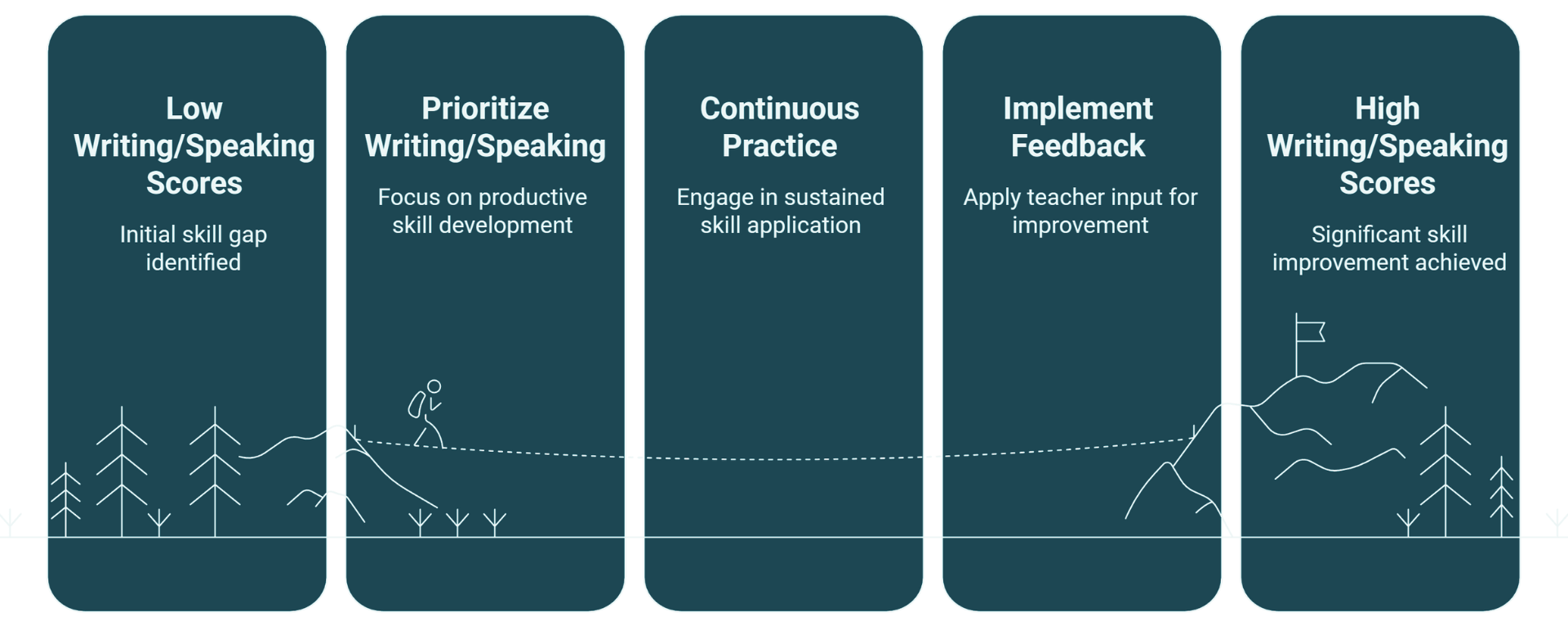
  • Lowest scores: Students typically score 0.5–2 bands LOWER in Writing/Speaking than Reading/Listening
  • Longer improvement cycle: Productive skills need 6–8 weeks of continuous practice to show gains
  • Feedback implementation: If Writing is Week 1–3, students have 5 MORE weeks to apply teacher feedback
  • Continuous practice: Learn Speaking in Week 1–2, practice it for remaining 6 weeks = massive improvement
  • Hardest to cram: Reading/Listening strategies can be learned quickly (1–2 weeks), but Writing/Speaking need sustained practice
Mastering Productive Skills Process

Revised optimal module order

Writing
Speaking
Reading
Listening
Classes 1–11

Writing

11 classes · hardest first

Classes 12–16

Speaking

5 classes · fluency + feedback

Classes 17–21

Reading

5 classes · strategy + vocab

Classes 22–24

Listening

3 classes · confidence finish

Weeks 1–3: Writing Module

Task 1 ladders (easy → hard), then Task 2 essays (easy → hard), capped with grammar rehab + mock. Every highlight below is already reflected on the homepage hero and modules section—you’re just seeing the full checklist in one place.

1

Week 1

Task 1 Foundation + Easy Types

Line graphs, bar charts, pie charts

  • Course launch + Writing introduction + strategic ordering reveal
  • Task 1 universal structure drilled with mandatory overview practice
  • Line graph live demo + 20-min writing sprint + peer review loops
  • Task 1 vocabulary packs: trends, comparisons, proportions
2

Week 2

Task 1 Medium → Hard + Task 2 Intro

Tables, processes, maps, mixed charts

  • Selective data strategy for dense tables + overview mastery
  • Passive-voice labs for process diagrams + sequencing language
  • Spatial language drills for map changes + direction fluency
  • Task 2 launch with opinion essays and PEEL paragraph labs
3

Week 3

Task 2 All Types + Grammar & Mock

Opinion → Advantages/Disadvantages → Problem/Solution → Discussion → Two-part

  • 40-minute planning timers + timed essay studios
  • Advanced cohesion + collocation upgrades pulled from Reading module
  • Grammar repair sprints on the top 10 IELTS errors
  • Full writing mock (Task 1 + Task 2) with peer + instructor feedback

Weeks 4–8: Practice never stops

Writing submissions continue even as modules rotate. Speaking gets five weeks total, Reading adds vocab power, Listening closes with a confidence spike.

1

Weekly Writing Rhythm (Weeks 4–8)

  • 1 Task 1 submission (cycling through all 7 visual types)
  • 1 Task 2 submission (cycling through all 5 essay types)
  • Feedback returned within 72 hours + rewrite guidance
SPEAKING ACCELERATOR

Weeks 4–5 Speaking Accelerator

Parts 1–3 + pronunciation labs

Week 4 checkpoint mock + pronunciation clinic
  • Part 1 answer-extension drills and accent confidence labs
  • Part 2 cue-card repetition method (record → repeat → refine)
  • Part 3 abstract discussion sprints with hedging + generalising language
  • Week 4 checkpoint mock with detailed pronunciation clinic
2

Reading Module (Weeks 6–7)

  • Easiest question types first (headings, diagrams, MCQ) → hardest (TFNG/YNNG)
  • Vocabulary harvesting for Writing + Speaking banks
  • Weekly full-passage diagnostics to measure +0.5–1.0 band jumps
3

Listening Module (Weeks 7–8)

  • Section-by-section mastery (Section 1 social chats → Section 4 lectures)
  • Active note-taking systems + spelling tournaments
  • Full mock test under exam rules before graduation

Why the order matters

The homepage already spells it out: hardest skills first, easy-to-hard inside each module, constant practice after modules "end." Here's the short list.

1

Easy → Hard Ordering

Writing hardest skill tackled first, inside-out: Task 1 complete ladder before Task 2, so learners build confidence and muscle memory.

2

Volume + Feedback

40+ Task 1s, 40+ Task 2s, 30+ speaking recordings, 50+ reading passages, 40+ listening drills—each with feedback loops.

3

Integrated Modules

Reading vocabulary feeds Writing, Speaking recordings repurpose Writing topics, Listening accent exposure powers Part 3 composure.

4

Measured Gains

0.5-2.5 band improvements across all sections: Listening 1-3 bands, Writing 0.5-2.5 bands, Speaking 1-2.5 bands, Reading 1-2.5 bands through sustained practice and mock-test checkpoints.

Why our strategic module order gets results

Most IELTS courses teach all four skills simultaneously, giving Writing and Speaking just two rushed weeks. We flip the script: hardest-first, easy-to-hard within each module, and continuous practice long after the lesson ends. That's how Bengali learners earn 0.5-2.5 band jumps in Writing.

1
Hardest skill first

Module 1 · Writing (Weeks 1–3)

Task 1 easy-to-hard visuals, then full Task 2 mastery with grammar labs and a Week-3 progress check. Writing practice continues weekly even after the module ends.

  • Line → bar → pie → tables → processes → maps → mixed charts
  • Opinion → advantages/disadvantages → problem-solution → discussion → two-part essays
  • Week 3 progress check + individual conference

Continuous Practice

Weekly alternating Task 1/Task 2 submissions through Week 8

2
Fluency & psychology

Module 2 · Speaking (Weeks 4–5)

Follow the test structure (Part 1 → 2 → 3), master pronunciation & repair strategies, then record full mocks with mindset reframing.

  • Confidence drills for Part 1 stories
  • Cue-card frameworks for Part 2 narratives
  • Part 3 argument training + Week 4 checkpoint & feedback

Continuous Practice

Bi-weekly recorded speaking drills through Week 8

3
Vocabulary boost

Module 3 · Reading (Weeks 6–7)

Question types progress from easiest to hardest so you never panic. Academic Word List drills immediately upgrade Task 2 vocabulary.

  • Matching headings → diagrams → MCQ → form completion
  • Sentence/summary/short answers → matching info
  • True/False/Not Given → Yes/No/Not Given → classification & list selection

Continuous Practice

Daily vocab loops feed back into Writing & Speaking

4
Confidence finish

Module 4 · Listening (Weeks 7–8)

Close with listening Sections 1 → 4 so you hit test day with momentum and a fresh Week-8 mock.

  • Section 1 social dialogues
  • Section 2 announcements
  • Section 3 academic discussions → Section 4 lectures

Continuous Practice

Focused listening drills + final comprehensive mock

Built for Bengali learners going from nervous to fearless

English Tinglish treats psychological barriers—not vocabulary—as the real bottleneck. Small batches, constant feedback, and culturally-aware coaching keep you accountable without overwhelm.

1

Strategic ordering

Writing (3 wks) and Speaking (2 wks) come first, giving the lowest-scoring skills eight and five total weeks of coaching + practice.

2

Easy-to-hard ladders

Never get thrown into mixed charts on day one—confidence grows one rung at a time.

3

Continuous practice

Module ends ≠ practice ends. Weekly writing & speaking submissions keep compounding.

4

Psychology-first coaching

We normalise test anxiety, perfectionism, and cultural pressure before polishing grammar.

5

Small batches

Maximum 20 students per section in a batch, individual conferences, named accountability.

6

Checkpoint mocks

Week 0 diagnostic (full IELTS), individual module mocks after each module (Classes 11, 16, 20, 24), and Week 8 comprehensive mock show progress without overload.

7

Research-backed results

0.5-2.5 band improvements in Writing when students get long-form practice—the heart of English Tinglish.

8

Mixed-level differentiation

Band 5 and Band 7 sit side-by-side with task-based scaffolding so everyone levels up.

Your 8-week journey

Saturday · Monday · Wednesday · 8:30 PM. 1.5 hours per session. Week 0 diagnostic (full IELTS), module mocks after each module (Classes 11, 16, 20, 24), and Week 8 comprehensive mock.

1

Diagnostic + Mindset Reset

  • Full mock + band analysis
  • Mindset workshop for Bengali learners
2

Writing Marathon

  • Task 1 ladder + Task 2 mastery
  • Week 3 progress check + conference
3

Weeks 4-5

Speaking Accelerator

  • Parts 1-3 + pronunciation labs
  • Week 4 checkpoint mock + pronunciation clinic
4

Reading Strategy Lab

  • Question ladders easy → hard
  • Reading sprints + vocab boost
5

Listening + Final Mock

  • Sections 1-4 drills
  • Week 8 comprehensive mock + celebration

By Week 8 you will have…

Effort fuels the transformation. This checklist is the minimum every Tinglish learner completes.

20+ Task 1 responses (all 7 visuals mastered)

20+ Task 2 essays across all 5 question types

15+ full speaking recordings (Parts 1, 2, 3)

30+ reading passages covering 14 question types

20+ listening drills across all four sections

1 diagnostic + 4 module mocks + 1 final comprehensive mock with scorecards + conferences

Vocabulary bank of 80+ Academic Word List words

35+ high-utility collocations + grammar fixes

Psychology toolkit to neutralise test anxiety

Individual action plan for test week

Results our students talk about

Specific band jumps, zero fluff. Your story is next.

N

Nabila · Band 7.0

""I entered at Band 5.5 (Writing 5.0). Starting with Writing meant eight straight weeks of essay practice. By Week 8 I had 42 essays marked, my anxiety was gone, and I scored Writing 6.5, Speaking 7.0.""

R

Rafi · Band 7.5

""The easy-to-hard ladder saved me. Tinglish made mixed charts feel normal, and the psychology sessions killed my perfectionism. Band 7.5 felt inevitable.""

Your questions, answered

Still unsure? Read through the most common questions from Bengali learners aiming for Band 7+.

Why do you start with Writing?

Writing and Speaking usually score lower for Bangladeshi students. Giving Writing 3 weeks of teaching + 5 more weeks of practice delivers 0.5-2.5 band improvements that our students consistently achieve.

What does easy-to-hard progression look like?

Line graphs precede mixed charts. Opinion essays precede two-part questions. Speaking Part 1 precedes Part 3. You always know the next step and never feel ambushed.

Can different band levels learn together?

Absolutely. Task-based learning with differentiation lets Band 5 focus on accuracy while Band 7 layers complexity, so everyone keeps improving.

Will I really write 20+ essays?

Yes. 10+ essays during the Writing module + alternating submissions afterwards = 20+. The same applies to 15+ speaking recordings.

What if I miss a class?

All sessions are recorded within 24 hours. Mock tests are live, but you can submit recordings for review. We still recommend 90%+ live attendance.

What results can I expect?

Your band scores will increase significantly across all sections. Listening typically improves by 1-3 bands, Writing by 0.5-2.5 bands, Speaking by 1-2.5 bands, and Reading by 1-2.5 bands. Most students see substantial improvements when they complete the full 8-week program with consistent practice.

Ready for the writing-first ride?

Secure your seat while the cohort is still capped at 20.

The Program Overview is exactly what the homepage promises—now it's your turn to live it week by week.